Thursday, July 5, 2012

The Reinvigorated Chris Tillman

It's a small sample size.  Against arguably the worst hitting team in baseball (especially at their home field).  That said, Chris Tillman wowed.  Many of us were at friends houses or barbecues or picnics to celebrate the 4th of July holiday.  Chris Tillman and the birds took on Seattle and Tillman showed why he was such a prized pickup in the Erik Bedard trade years ago.

I always liked Tillman because he throws a knuckle-curve (and a nasty one at that) which was the same curveball I threw growing up.  You might remember a former Oriole pitcher that was pretty successful with that same pitch as well.  As a result, Tillman has a soft spot in my heart, and I've always been pulling for him, beyond what you typically would for any young Oriole.

We've been hearing for weeks that Tillman has been pitching well in the minors, albeit not going very deep into games.  He'd pitched to a 3.63 ERA in Norfolk but his FIP suggests he'd pitched better than that.  Tonight he went 8.1 IP with 2 Hits, 2 Runs, 2 Walks and 7 Ks.  Here's how he did it:

Pulled from Brooks Baseball

As you can see, Tillman sat in the mid 90s with his various fastballs, the 4-seamer averaging 95 MPH and the Cutter coming in at 93.  Tillman topped out at 97.2 MPH on the night, much higher than he threw last time O's fans saw him (in 2010 Tillman's FB averaged 90.2 MPH, in 2011 it was just 89.3).  The Cutter was a pitch that Tillman added to his repoirtoire in 2011, but only threw it about 5% of the time.  This trend holds here as just 7 of Tillman's 121 pitches were cutters.  The Cutter is a useful tool for him though, as you can see below:
From Brooks Baseball

This image shows the horizontal movement by speed for Tillman in the game.  The key is on the right, and you can see that 4-Seamers are green, Cutters - black, Changeups - yellow, Curves - purple.  You can see above the distinct clusters for Tillman on his 3 main pitches the 4-Seam Fastball, Curveball and Changeup.  The Cutter is clustered to the right of the 4-Seamer, with slightly less velocity, but positive movement.  This means that all of Tillman's fastballs moved to the arm side (as you would expect) except the Cutter which Tillman can use to fool hitters.  A perfect example of this is in the 4th inning where Tillman struck out Casper Wells with a well placed Cutter:
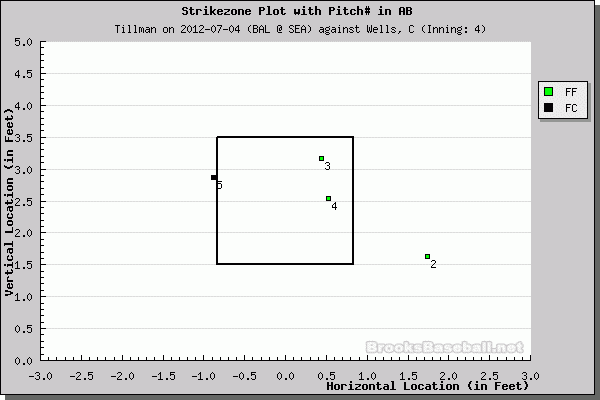
From Brooks Baseball
The 5th pitch in the AB was a perfect Cutter on the inside corner that Wells presumably expected to continue moving in off the plate.  Again, we're talking about 5% of all the pitches Tillman will throw in a game, but that's also why it's an effective tool for him.

I'm emphasizing the Cutter here because I think at the velocity he had today, Tillman really has multiple tools at his disposal to put away hitters.  I've always found Tillman's curve to be especially filthy.  For him it was a question of velocity and control.  Today Tillman showed he had velocity and he had control.  His excellent secondary offerings are what made him so intriguing just a few years ago.  It's a small sample size, against one of the worst hitting teams in baseball.  Despite that, I'm intrigued and I can't wait to see Tillman's next turn after the All-Star Break.  If this Tillman is what we'll get for the rest of the season, we may have just found our new #3 starter.

Saturday, June 30, 2012

Orioles Trade Lino, Simon for Thome

Warning: Eutaw Street-goers beware.

The Trade

The O's have sent two minor leaguers to the Phillies for Jim Thome, who will likely DH for the club going forward.  The minor leaguers in question are RHP Kyle Simon and C Gabriel Lino.  Simon was a 4th round pick who has been putting up decent numbers at Frederick: 3.96 ERA, 1.48 WHIP in 14 starts.  Lino is a 19 year old prospect who has the potential to be plus defensively behind the plate and could hit for big power.  Question mark on Lino is his ability to hit enough to get to that power according to Kevin Goldstein.

Thoughts

Lino isn't lighting the world on fire, but has shown flashes of the potential he has at Delmarva this season.  The real question for me is one of value.  What does Thome give you that Betemit, Reynolds and Johnson don't?  Thome just isn't a huge upgrade for the O's because he represents a slightly better version of a guy we already have 3 of.

So the value for us is marginal, and the value for the Phils is pretty solid.  Thome likely wouldn't start at 1B so they're selling high on a guy who is raking as a DH in interleague play.  The O's give up Simon, a decent relief prospect and Lino.  My big issue here is Lino, as he's a high upside guy.  Granted, he isn't likely to reach that upside, but he's an interesting prospect nonetheless.

In the moment this seems like an overpay for a guy that likely won't help the O's win all that many more games this season.  That said, this is hardly the end of the world, and we could certainly use some more pop in the middle of our lineup.  At the end of the day, it's really not a big deal either way. I just think that if the O's are going to be sending prospects elsewhere they should be focusing on guys who could be bigger upgrades to the roster.

As with any trade, time will tell. Would love to hear your thoughts on the move in the comments.

Friday, June 22, 2012

Buck Showalter: Tactical Genius?

Jim Johnson's Dominance

Let's start this conversation by saying that this is going to be one of those stat-heavy posts.  In this case we'll be utilizing the win probability data from fangraphs, which you can find here.  The first point I'd like to note is that according to Win Probability Added, Jim Johnson is the best pitcher in baseball this season with a fairly sizable lead over Justin Verlander.  Here's an explanation of WPA if you're not familiar with the stat.  Not necessarily that important, just something interesting to think about as we look at the bullpen usage more in depth.

Buck Showalter's Bullpen Usage

The stat I really want to focus on is gmLI which basically gives an indication of how intense the situation is when the pitcher enters the game.  Using the same page from before we can sort the pitchers who have thrown at least 10 innings in MLB by gmLI.  If you want more info on Leverage Indices and how they work, click on the link in the first sentence of this section.

As you can see, Jim Johnson is tied for 9th in MLB with an average leverage index of 1.79 for the games he enters.  As stated in the fangraphs explanation, anything above 1 is an average leverage appearance, so that figure shows that Buck is using his best pitcher in the most critical situations.  Johnson's 1.79 leverage index leads the Orioles, but looking at the rest of the staff gives more insight into how Buck has used the bullpen.

If we sort out the Orioles' pitchers we can look at the average leverage index when each guy enters the game, and get an idea of who pitches in the highest leverage and lowest leverage appearances.  Johnson paces the O's with a gmLI of 1.79, followed by Strop at 1.71.  These two guys have pitched in the most crucial situations, and their performances have backed up Buck's aggressive usage.


The O's also have a bunch of pitchers between average leverage at 1.00 and 1.16, slightly above average.  From most to least these guys are: Ayala, Lindstrom, O'Day and Patton.  All of these guys have provided quality innings out of the bullpen, though these mainly come earlier in games which might play a role in their lower gmLIs.  At the opposite end of the spectrum Kevin Gregg and Dana Eveland bring up the rear with 0.81 and 0.60 gmLIs.  These are almost certainly a function of their usage, as Gregg rarely pitches in close games and Eveland is the de facto long-man coming in when a starter exits early.

What Does It Mean?

Well to assess the seasons these guys have had, we'll use a stat called ERA-.  Basically ERA- adjusts a pitchers ERA for their league, home park, etc.  For this particular stat a score of 100 would be league average, and the lower your number is the better.  Here are the ERA- stats (among other stats) for the O's pitchers:


Johnson, Lindstrom and Strop have absurd ERA- stats of 29, 31 and 34 respectively, showing that they've been absurdly better than league average to this point.  O'Day and Ayala both also have scores below 50.  This presents an opportunity for Buck to perhaps spread out some of the high leverage situations among these guys as well as they've shown the capability to handle it.  Will they be this good for the whole season?  Probably not.  What we have, and can hope to continue to see is that Buck using his pitchers well. I'm thinking of Buck putting Jim Johnson out there in tie games against the Phils and Yankees earlier this season rather than saving him for the "traditional save chances".

Buck has used the bullpen really well so far this season despite them having to throw a lot of innings.  That said, he needs to continue to manage the bullpen well to put guys in positions to succeed.  Using Johnson as he has allows him to utilize his best pitchers in the most critical situations - giving the O's the best chance to win.  Buck's decision on the lineup and who starts where might be questionable, but his usage of the pitching staff has been really solid so far.

Monday, June 18, 2012

Who in the world is Steve Pearce?


With the injury bug hitting the Orioles outfield they have had to try different players in different positions. One of them is Steve Pearce.

Pearce was acquired by the Orioles on June 2nd in a deal with the New York Yankees. Pearce was absolutely crushing in Triple-A Scranton Wilkes-Barre, hitting .321 with 11 home runs and an OBP of .422.

For fans that follow baseball really closely Pearce may be a familiar name.

Pearce was drafted in the 8th round by the Pittsburgh Pirates in the 2005 MLB Draft after attending the University of South Carolina and leading the team in average, home runs, and runs batted in.
Pearce never had a hard time hitting in the minors. However, his big year came in 2007 when he was named MLB.com Minor League Player of the Year and he was also a Futures Game Selection. 

Throughout three levels Pearce hit .333 with 31 home runs and 113 runs batted in. On September 1st the Pirates called Pearce up and he played 23 games for them in September.

In 2008 Pearce was called up on several different occasions and in 2009 he failed to make the Opening Day roster but he got his chance when the Pirates traded their starting first baseman Adam Laroche. Pearce failed to impress however.

In 2011 Pearce finally the Pirates Opening Day roster but only hit .202 in 50 games.

Pearce’s time with the Pirates finally came to an end and he signed with the Minnesota Twins. However, the Twins released him at the end of Spring Training and he was immediately scooped up by the Yankees.

Once the O’s traded for Pearce, he immediately was inserted into the line-up the next day. Pearce has had a very solid start with the Orioles, hitting a cool .324 in 10 games, to go along with 1 home run and 9 runs batted in.

Don’t get too crazy though Orioles fans, Pearce has yet to prove it in the major leagues and is considered a “Quad-A” player, which is someone who can hit in the minor leagues but can’t hit in the major leagues.

However, Orioles fans should hope Steve Pearce can be a solid fill-in while the Orioles wait for Nick Markakis and Nolan Reimold to return from injury.

Tuesday, June 12, 2012

Baltimore Orioles: Trade Deadline Buyers?

Buy/Sell/Hold

Dave Cameron of Fangraphs wrote a piece yesterday breaking down every MLB as either potential buyers, sellers or holders at this year's trade deadline.  He broke down the buyers into two groups: 'likely buyers' and 'buyers' so separate out those firmly entrenched in picking up talent from those who might buy, but might not.

Cameron listed the Orioles as 'likely holders' at the deadline suggesting that despite playing over their heads to this point, they could hope to hold on to veterans with the outside shot at a second wild card spot.  Cameron suggests that teams like the Orioles, Mets or Pirates could benefit greatly from a rare playoff appearance with a 're-energized fanbase'.

Are The O's Buyers?

Many fans certainly want the O's to be buyers at the deadline.  Over the past month or so fans have been clamoring for the home team to go look for a third baseman, starting pitch depth, even an ace to anchor our rotation.  Apparently Dan Duquette said some thing along the lines of, "If we're in it in July we'll be in it to win it. We're out right now taking stock of our minor league system to see what we have to offer teams" prior to the game on Friday June, 8th.  Does this mean the O's are looking to trade?  Who can we get?  Is Garza up for trade?  These, and hundreds of other questions undoubtedly start surfacing looking for ways to push the Orioles into contention.

I don't know what Dan Duquette and the baseball operations team in the warehouse are thinking with regards to trade targets.  If you want an answer for that, try calling up the executive offices and ask the operator to speak to Dan himself.

What I can tell you is what I would do if I were GM - what I think the Orioles should do.

What We Should Do

Recent success in MLB is predicated on developing and bringing up a stream of talented young players that can fill in holes left by veterans.  We're not talking about the Yankees here, the Orioles are not the Yankees and likely never will be.  What the Orioles can be is a middle ground between the Rays and Red Sox.  The model used by Tampa, Texas and Boston to a lesser degree has proven to be successful time and time again.

What exactly is that model you ask?  Fill the farm system with talent, build up a strong core on your roster, and then add pieces to fill in holes as necessary.  This does not require, nor does it preclude you from making splashy free agent signings.  A perfect example is Texas, the best team in baseball the past 2 seasons despite missing out on winning rings.  Texas built up a core of Hamilton, Andrus, Kinsler, Young, Cruz etc by acquiring talent and letting it develop.  Then, when the team was ready to compete they went out and brought in Adrian Beltre to hold down 3B.

The Orioles are starting down this path with promising young players surrounding established young veterans like Wieters and Jones.  The future of Machado, Schoop and Bundy gives the Orioles a core to build around and add to.  This should be the basis of the team going forward.

So Let's Trade For Our Core!

Not so fast.  Trading, especially in a seller's market, will be expensive as Cameron points out.  It will take 2 or 3 top prospects to get a guy like Matt Garza.  Sure, maybe acquiring a guy like him puts us in the playoffs this season, but we won't have guys to call up a year or two from now to add on to our roster.  We'd be trading in long-term sustainable success for one potential playoff appearance.

I know Oriole fans have been waiting way too long for a playoff run.  I know that being patient is hard and knowing we could have made the playoffs if we just made one move is worse.  The fact of the matter is that baseball is getting younger, and the Orioles can't afford to be short-sighted and accept another long stretch of losing for one shot at the postseason.

It's been a long and arduous journey as an Oriole fan, but there's finally a light at the end of the tunnel.  Rather than sprinting to the light and having to stop just outside the exit of the tunnel let's pace ourselves so we can keep running once we break through.